




People & Personalities
Mufti Kifayatullah: Hazara’s Enigma, A Raging Storm and a Silent Statement.
09-Nov-2026 — Qazi Jawad
0 Comments
34 Views
اردو میں پڑھیں
By: Mushtaq Ahmed Azad
It is often said that some people stand within a crowd, while others possess the ability to create a crowd simply by their presence. Some voices strike the ears and disappear, while others penetrate hearts and become part of the collective memory of an era. In politics, too, there are individuals whose presence can transform an ordinary gathering into a movement, silence into protest, and a single gesture into a significant public response. Mufti Kifayatullah is one such personality in the political and social landscape of Mansehra.
In the streets, markets and public squares of Mansehra, when a personality manages to attract people's attention within moments, when a large gathering comes together at short notice, and when a speech fills the atmosphere with slogans, it is not merely the influence of a name. Behind it lies years of political association, public engagement and organizational influence. One of the most distinctive qualities of Mufti Kifayatullah is his remarkable ability to mobilize people and attract public gatherings. When he will enter the political arena, when he will raise his voice, and what political position he will adopt are often difficult to predict. This unpredictable political approach has given him a distinct identity in Mansehra's politics.
Simplicity remains one of the defining characteristics of his personality, while fearlessness is an essential part of his temperament. Belonging to the historic land of Baffa, Mufti Kifayatullah is connected to a religious and intellectual tradition that has been strengthened by distinguished figures such as Mujahid-e-Millat Maulana Ghulam Ghaus Hazarvi. He has remained associated with religious activities and the movement for the protection of Khatm-e-Nabuwwat (the Finality of Prophethood). His journey from local politics to becoming a Member of the Provincial Assembly (MPA) on the platform of Jamiat Ulema-e-Islam was an important milestone in his political career. His supporters regard his simplicity, religious commitment and lifestyle as defining aspects of his character. Despite having served in the provincial assembly, his continued association with teaching Hadith at a small seminary in Tarangri Sabir Shah reflects the importance he attaches to his religious responsibilities.
However, over time, differences and organizational complexities also emerged within Mansehra's local political circles. Disagreements involving Mufti Nasir Mahmood and his associates over organizational and electoral matters affected the local political environment. Certain circles also raised questions about the relevant election results, describing them as a consequence of Form 47, although this remains a contested political position. Instead of withdrawing from the political landscape, Mufti Kifayatullah and Mufti Saeed Abdullah established an alternative organizational platform known as the Markazi Seerat Committee.
Within a relatively short period, the Markazi Seerat Committee expanded its activities beyond Mansehra and established its presence in different parts of Hazara Division. Its gatherings and public activities attracted considerable participation, giving it a notable position at the local level. The joint strategy, mutual cooperation and organizational connections of Mufti Saeed Abdullah and Mufti Kifayatullah are regarded as important factors behind this development. Mobilizing people at short notice and organizing large gatherings across different areas have become some of the platform's distinguishing features.
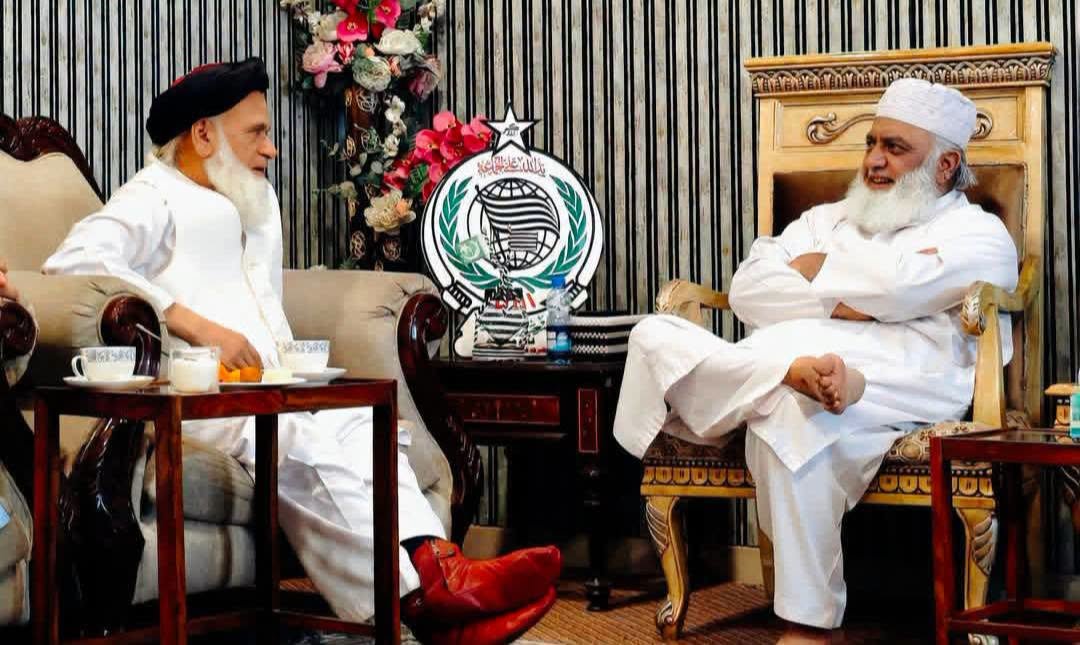
A few days ago, when the convoy of Jamiat Ulema-e-Islam chief Maulana Fazlur Rehman arrived in Mansehra, various political activities and discussions emerged within local circles. Some observers interpreted the situation in the context of organizational distance and silent differences, although no formal boycott announcement was confirmed. Meanwhile, Mufti Kifayatullah's meeting with Maulana Fazlur Rehman attracted considerable attention across the political landscape.
Was the meeting merely a formal interaction, or did it carry a broader organizational and political message? It would be premature to draw a definitive conclusion. However, after photographs of the meeting appeared on social media, a fresh wave of political discussion began.
One of the photographs was accompanied by the following caption:
I have devoted an entire lifetime to you; you are my most precious asset."
The second photograph carried another caption:
A beautiful meeting in the city of power, challenging the arrogance of the self-proclaimed influential and the carefully constructed narratives."
Both captions carry symbolic meaning. The first reflects the impression of a longstanding relationship between a teacher and his student, built on trust, respect and association. The second appears to highlight the political differences and organizational tensions surrounding the meeting. Regardless of their intended interpretations, the photographs have certainly sparked a new debate in Hazara's political circles.
At this point, an important question deserves attention: Why has a personality with Mufti Kifayatullah's religious and political background not been given the prominent organizational responsibilities that many of his supporters believe he deserves within the central and provincial structures of Jamiat Ulema-e-Islam?
Is his willingness to express disagreement, raise questions about organizational matters and openly present his views a factor behind his perceived distance from important decision-making circles? Or are there other organizational strategies and political considerations involved? Only the party leadership and relevant organizational representatives can provide a definitive explanation.
One important reality is that the strength of any political party does not depend solely on its central offices or organizational structure. It also depends on capable, active leaders and workers who maintain strong connections with the public. If differences of opinion are treated as opportunities for consultation and improvement rather than organizational weaknesses, political institutions can become stronger. In Mufti Kifayatullah's case, the central question is how the party intends to benefit from his experience, abilities and public influence.
Whether Mufti Kifayatullah currently holds an important organizational position or not, his political identity and public presence remain significant realities. His supporters expect him to be considered for responsibilities such as membership of the Central Executive Committee, Provincial General Secretary or Provincial President. However, appointments to these positions remain subject to the party's organizational procedures and leadership decisions.
History offers an important political lesson: positions may give individuals recognition, but sometimes an individual's character and contributions give recognition to the position itself. What ultimately matters is the place a political leader establishes in society through ideas, character, public engagement and principled positions.
The same fundamental question applies to Mufti Kifayatullah: Will he be entrusted with organizational responsibilities that reflect his abilities? Will his differences of opinion be accommodated, allowing him to become part of the mainstream organizational structure? Or will his role in Hazara's politics continue to develop through a separate and independent political and organizational identity?
For now, the answers remain uncertain. However, his recent meeting with Maulana Fazlur Rehman has once again highlighted that political differences do not necessarily erase the importance of personal relationships, mutual respect and longstanding associations.
Because in politics, some meetings are never merely meetings; they leave behind questions, possibilities and messages that are often conveyed without words
Comments (0)
No comments yet — be the first to comment.
Leave a Comment